Davis County Dog Registration Information
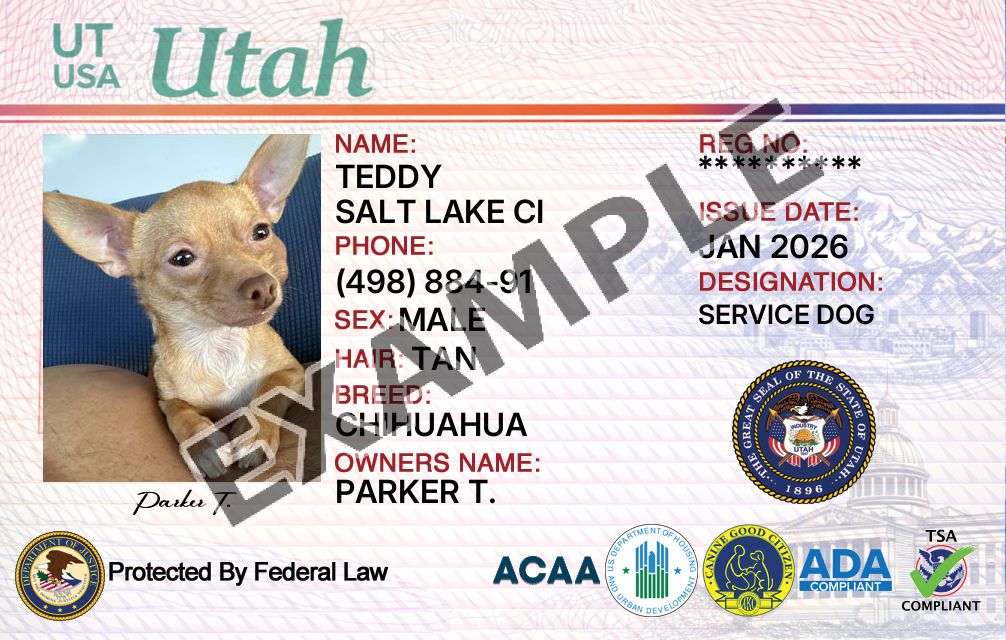
Service Dogs and Emotional Support Animals in Davis, Utah
Registering a Service Dog or Emotional Support Dog in Davis County, Utah: What “Registration” Really Means
If you’re searching where do i register my dog in Davis County, Utah for my service dog or emotional support dog, the key thing to know is that there usually isn’t a single “service dog registry” or “ESA registry” that makes a dog legally a service animal or emotional support animal. Instead, most residents need a dog license in Davis County, Utah, which is an animal control / public health requirement tied closely to rabies vaccination. Service dogs can have specific fee rules, but they still generally must be licensed. Emotional support animals (ESAs) do not receive the same public-access status as service dogs, and they typically do not qualify for service-dog licensing waivers.
Where to Register or License Your Dog in Davis County, Utah
Because dog licensing is often handled locally, the offices below are good starting points for where to register a dog in Davis County, Utah. In many cases, Davis County Animal Care is the primary agency for licensing and animal control services across Davis County cities, including rabies-related enforcement and field services.
Official Licensing & Animal Control Offices (Examples)
| Office | Address | Phone | Hours | |
|---|---|---|---|---|
Animal Care of Davis County (Licensing & Shelter)Primary county animal services office
|
1422 E 600 N Fruit Heights, UT 84037 |
(801) 444-2200 | animalvaccines@co.davis.ut.us |
Mon–Fri: 10:00 AM – 6:00 PM
Sat: 12:00 PM – 4:00 PM
|
Animal Care of Davis County (Field Services Dispatch)Complaints, bites, aggressive dogs, enforcement questions
|
Same agency as above (dispatch support for field services) |
(801) 444-2200 Press 6 for Animal Care Dispatch |
Not listed on the dispatch FAQ page |
Mon–Fri: 8:00 AM – 6:30 PM (Dispatch)
After hours: transferred to county dispatch per agency instructions
|
Davis County Animal Care (General Contact Email)General county animal services contact
|
Davis County Animal Care (countywide) | Use the main phone listed above if needed | animalcontrol@daviscountyutah.gov | Not listed with the email listing |
Note: This table lists official examples with publicly available contact details. If you live within a Davis County city (such as Layton, Bountiful, Farmington, Syracuse, Kaysville, Clearfield, etc.), your city may publish additional guidance, but county animal services is typically the central licensing and animal control resource.
Overview of Dog Licensing in Davis County, Utah
What a Dog License Is (and Why It Matters)
A dog license in Davis County, Utah is a local registration record for your dog that helps animal control return lost pets, confirms key public health requirements (especially rabies vaccination), and supports animal services in your community. In day-to-day life, the license is often represented by an official tag, but the important part is the licensing record connected to you and your dog.
Basic County Rule: When a License Is Required
Davis County Animal Care states that (per county code referenced by its Field Services FAQs) dogs over 4 months old that reside in Davis County for more than a short period are required to be licensed. The same guidance is also tied to rabies vaccination: county licensing information indicates that a license cannot be valid when rabies vaccination is not current.
Rabies Vaccination and License Validity
In Davis County, licensing is closely linked to rabies prevention. County licensing guidance explains that a pet license may not be valid at any time the rabies vaccination is expired, and that proof of current rabies vaccination is required to obtain a license. Practically, this means “registration” often starts at your veterinarian: get the rabies vaccine (and keep the certificate), then apply for the license using the licensing options available to your local jurisdiction.
How Dog Licensing Works Locally in Davis County, Utah
Countywide Animal Services, Local Residency Details
Many residents interact with Davis County Animal Care for licensing and enforcement questions (loose dogs, bites, rabies-related follow-up, and more). At the same time, “local” still matters: your exact process can depend on whether you live in a particular city (like Layton or Bountiful) or in an area governed more directly by county code. If you’re unsure which rules apply, start with Davis County Animal Care and confirm your address and jurisdiction.
Common Ways to Get Licensed
Davis County Animal Care describes multiple methods for licensing, which commonly include online, mail-in, and in-person options. For first-time licensing where documentation must be reviewed (such as certain discounted/verification-based license types), you may need to go in person so staff can verify the paperwork.
Service Dogs: Licensing Still Applies (Fee Rules May Differ)
Davis County Animal Care explains that dogs that qualify as service animals must still be licensed, but that license fees can be waived for qualifying service animals (and it explicitly notes this does not include emotional support animals). If you are licensing a guide/assistance dog for the first time, county licensing instructions indicate this may need to be done in person for initial verification.
Late Renewals and Enforcement
Licensing programs typically have renewal timelines and may assess late fees or penalties for failure to license. Davis County’s licensing guidance notes a late fee after a stated period following expiration and warns that failure to license may result in a fine. Because enforcement details can vary by situation (lost dog pickup, complaint-based enforcement, or rabies/bite investigation), it’s wise to keep the license current and maintain copies of your rabies certificate and any spay/neuter or microchip documentation you plan to use for a discounted rate.
Service Dog Laws in Davis County, Utah
Service Dog Status Is Not a “Registry”
A service dog’s legal status generally comes from what the dog is trained to do (work or tasks related to a disability) and how it behaves in public—not from buying an ID card or registering with a private website. For public-access settings, the standard rule is that if it’s not obvious what service the dog provides, staff may ask only limited questions, commonly summarized as two questions: whether the dog is required because of a disability, and what work or task the dog has been trained to perform.
Service Dogs and Local Dog Licensing
Even if your dog is a legitimate service animal, you generally still need to comply with local animal control laws such as rabies vaccination and licensing. In Davis County, county animal services specifically indicates that service animals must be licensed, though the fee may be waived for qualifying service animals (with emotional support animals excluded from that waiver). In other words: service dog rights are about access and nondiscrimination; a dog license is about local public health and animal control compliance.
Practical Tips for Service Dog Handlers Getting Licensed
- Keep your dog’s rabies vaccination current and retain the certificate for licensing.
- If you are requesting a service-dog fee waiver, confirm what documentation the county requires and whether your first license must be processed in person.
- Remember that a vest, ID card, or “certificate” is not automatically required for service dog status, even though some handlers choose to use gear for clarity.
Emotional Support Animal Rules in Davis County, Utah
An ESA Is Not the Same as a Service Dog
Emotional support animals can be helpful for a person’s mental or emotional health, but they are not the same as service dogs for public access. In most day-to-day public places, ESAs generally do not have the same legal right to enter where pets are not allowed. That distinction is one reason people searching where do i register my dog in Davis County, Utah for my service dog or emotional support dog end up confused: licensing is local and official, while “ESA registration” sold online is usually not what landlords, employers, or public businesses rely on.
ESAs and Dog Licensing in Davis County
If your dog is an ESA, you still typically need the standard animal control dog license Davis County, Utah residents are required to maintain (including rabies compliance). Davis County Animal Care’s guidance about service animals notes that fee waivers for service animals do not include emotional support animals. That means your ESA is usually licensed like any other pet dog, based on your jurisdiction and documentation (rabies certificate, potential spay/neuter or microchip documentation for discounted rates where applicable).
Housing Context (General Guidance)
ESAs are most commonly relevant in housing situations where disability-related accommodations may apply. However, housing rules are separate from dog licensing. Even when an accommodation is appropriate, local rabies vaccination and licensing requirements typically still apply. If you are dealing with a housing request, keep your paperwork organized, but don’t skip the local license—because “registration” for an ESA does not replace the county/city dog license.
Frequently Asked Questions
Disclaimer: Licensing requirements and office locations may change. Residents should verify details with their local animal services office within Davis County, Utah.
Register A Dog In Other Utah Counties
Select your county below to get started with your dog’s ID card. Requirements and license designs may vary by county, so choose your location to see the correct options and complete your pup’s registration.
- Beaver County Dog Registration
- Box Elder County Dog Registration
- Cache County Dog Registration
- Carbon County Dog Registration
- Daggett County Dog Registration
- Duchesne County Dog Registration
- Emery County Dog Registration
- Garfield County Dog Registration
- Grand County Dog Registration
- Iron County Dog Registration
- Juab County Dog Registration
- Kane County Dog Registration
- Millard County Dog Registration
- Morgan County Dog Registration
- Piute County Dog Registration
- Rich County Dog Registration
- Salt Lake County Dog Registration
- San Juan County Dog Registration
- Sanpete County Dog Registration
- Sevier County Dog Registration
- Summit County Dog Registration
- Tooele County Dog Registration
- Uintah County Dog Registration
- Utah County Dog Registration
- Wasatch County Dog Registration
- Washington County Dog Registration
- Wayne County Dog Registration
- Weber County Dog Registration